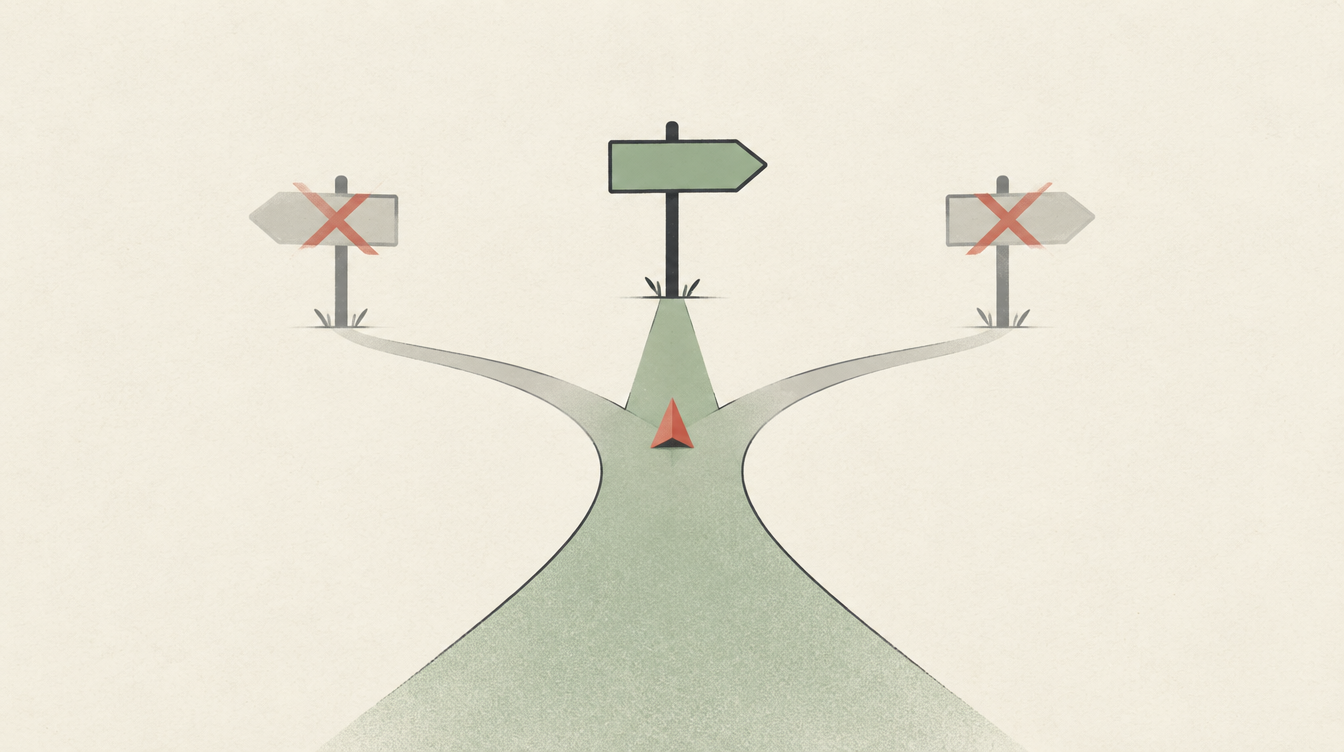

Growth is one of the easiest things for a business to celebrate.
More customers. More revenue. More products. More markets. More people. The numbers go up, the announcements follow, and the business appears to be moving in the right direction.
But growth and progress are not the same thing.
Growth tells you that something is increasing. Progress tells you that the increase is taking you somewhere worth going.
A company can grow its customer base while making its customer experience worse. It can increase revenue while reducing profitability. It can launch more products while making its value proposition harder to understand. It can expand into new markets while weakening the business that made it successful in the first place.
The activity is real. The growth may be real, too. But the strategic value is less obvious.
The problem with measuring what is easy to count
Businesses need numbers. Revenue, retention, conversion, market share, customer acquisition cost—these measures help leaders understand performance and make decisions.
The problem begins when a measure becomes the objective.
When teams are rewarded for generating leads, they may optimize for lead volume rather than lead quality. When success means launching products, the organization may prioritize launches over adoption. When growth becomes the dominant goal, decisions that improve the business slowly can lose to decisions that make the dashboard look better quickly.
This is not necessarily a failure of measurement. It is a failure to connect measurement to purpose.
A number can tell you what changed. It cannot, by itself, tell you whether the change matters.
Growth can hide the real problem
Growth is particularly persuasive because it can make underlying weaknesses harder to see.
A business may compensate for poor retention by acquiring more customers. It may cover an unclear positioning strategy with more advertising. It may respond to weak differentiation by adding features. It may use expansion to avoid confronting a business model that is not working as well as expected.
Each move can produce visible activity. Some may even produce short-term results.
But if the underlying problem remains, the business is not solving it. It is building around it.
Over time, that becomes expensive. More customers require more support. More products create more complexity. More markets demand more resources. The organization becomes larger, but also harder to operate.
Growth has increased the size of the problem rather than resolving it.

Progress requires a direction
Progress is not simply doing more of what already works. It requires a clearer understanding of what the business is trying to become.
That means asking different questions.
Not only: How much did we grow?
But also: What became easier for our customers? What improved in the economics of the business? What capability did we build? What risk did we reduce? What did we learn that changes our next decision?
These questions connect results to direction.
They also make trade-offs visible. A company might deliberately slow acquisition to improve retention. It might postpone a product launch to strengthen the core experience. It might leave a market to focus on the customers it can serve exceptionally well.
Those decisions may look like slower growth in the short term. They can still represent meaningful progress.
The difference shows up in the next decision
The distinction between growth and progress becomes useful when it changes what a company does next.
If revenue is increasing but margins are shrinking, should the business continue pursuing the same customers? If product usage is rising but customers still struggle to achieve their goals, is adoption really the right measure of success? If the company is expanding rapidly but losing clarity about why customers choose it, what exactly is being scaled?
The point is not to distrust growth. Growth matters. Businesses need to expand, compete, and create economic value.
The point is to stop treating growth as proof that the strategy is working.
A better measure of success considers not only how much the business has gained, but what it has become capable of doing—and whether that capability creates lasting value.
Because a bigger business is not automatically a stronger business.
And a rising number is not automatically a sign of forward movement.
Growth tells you how much has changed. Progress tells you whether that change was worth making.