
Strategy is one of those words that gets used so often that it can start to lose its meaning.
Almost every business has a strategy.
A list of goals. A roadmap. A set of priorities. A presentation explaining where the company wants to go.
But having all these things does not necessarily mean a business has a strategy.
Sometimes, it simply means the business has a long list of things it wants to accomplish.
And that is where the problem begins.
When everything becomes a priority
Imagine a company that wants to grow.
It decides to enter new markets, launch new products, improve customer experience, invest in technology, strengthen its brand, generate more leads, and increase sales.
Every initiative makes sense on its own.
Each department can explain why its project matters.
The roadmap looks ambitious. The presentation looks convincing. Everyone has something to work on.
But six months later, progress is slower than expected.
Budgets are stretched. Teams are busy. Decisions take longer. Important projects compete for the same people and resources.
The company is doing more, but moving forward less than it expected.
The problem may not be the quality of its initiatives.
It may be the absence of clear choices between them.
When everything matters equally, nothing receives the attention it needs to succeed.
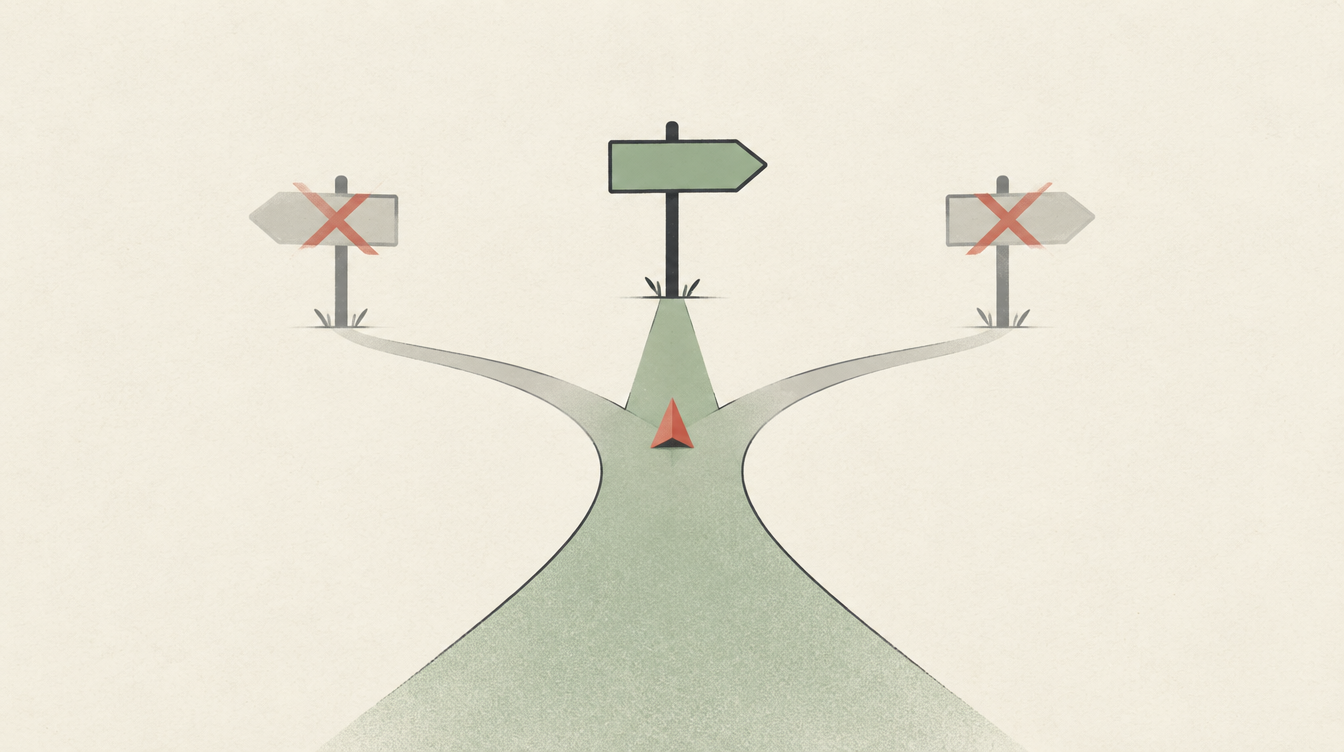
Strategy starts with a choice
A useful strategy does more than describe a desired future.
It makes choices about how to get there.
Which customers matter most?
Which problems are worth solving?
Where can the business create a meaningful advantage?
Which opportunities deserve investment now, and which can wait?
These questions are uncomfortable because every meaningful choice creates an alternative that will not be pursued.
Choosing one market may mean postponing another.
Investing in one product may mean delaying a different initiative.
Serving a specific customer segment exceptionally well may mean accepting that the business cannot be everything to everyone.
That is not necessarily a limitation.
It is how focus becomes possible.
A strategy becomes meaningful when it changes what the business chooses to do—and what it chooses not to do.
The hidden cost of saying yes
Businesses rarely struggle because they lack opportunities.
More often, they struggle because they find it difficult to say no to them.
A promising partnership appears. A competitor launches something new. A customer requests a feature. Someone proposes entering a market that looks attractive.
Each opportunity creates pressure to respond.
And because each one can be justified individually, rejecting any of them feels difficult.
But opportunities have costs beyond their price tags.
They consume management attention, team capacity, time, and the ability to execute other priorities well.
The cost of pursuing an opportunity is not only what you spend on it.
It is also what you can no longer give your attention to.
This is why a company can have strong people, a healthy budget, and plenty of ambition—and still struggle to execute.
Its resources may be spread across too many directions.
Being busy is not the same as making progress
One of the most misleading things in business is visible activity.
More campaigns. More meetings. More features. More markets. More reports.
Activity is easy to observe.
Progress is harder to measure.
A marketing team can publish more content without improving demand.
A sales team can hold more meetings without creating better opportunities.
A product team can release more features without making the product more valuable to customers.
In each case, the activity may be real. The effort may be considerable.
But the business outcome may remain unchanged.
This does not mean every initiative must deliver immediate financial results. Some investments build capabilities, generate learning, or create advantages that take time to appear.
The question is whether the activity serves a deliberate strategic choice.
If you cannot explain how an initiative contributes to the direction of the business, it deserves a closer look.
Not every worthwhile activity is strategic.
And not every strategic priority requires more activity.
Sometimes, the right decision is to stop doing something that consumes resources without meaningfully advancing the business.
Focus is not the same as doing less
There is an important distinction here.
A company can reduce the number of projects it runs and still have no real focus.
It can cut budgets without clarifying its direction.
It can simplify its roadmap without deciding what makes it different.
Focus is not simply a smaller workload.
It is a stronger connection between what the business wants to achieve and how it chooses to spend its resources.
That connection should be visible in everyday decisions.
When a new opportunity appears, the team should have a way to evaluate it.
When two priorities compete, there should be a clear basis for deciding between them.
When a project stops making sense, the organization should be able to reconsider it without treating the original decision as untouchable.
A strategy is not a document that protects decisions from change.
It is a framework that helps people make better decisions as circumstances change.

What should you stop doing?
I find this question particularly useful when reviewing a business strategy.
We often ask what we should start doing.
What new market should we enter? What product should we build? What channel should we invest in? What capability should we develop?
These are important questions.
But there is another set worth asking:
What are we doing that no longer supports our direction?
Which initiatives exist because we have always done them?
Which opportunities are attractive but distracting?
Where are we spreading our resources too thinly?
What would we stop if we had to concentrate our effort on the two or three things that matter most?
The answers may reveal more about the quality of a strategy than another list of ambitious goals.
They expose the gap between what the business says matters and what it actually prioritizes.
A strategy should make decisions easier
A good strategy does not eliminate uncertainty.
Markets change. Customers behave unexpectedly. Competitors move. Assumptions turn out to be wrong.
No strategy can predict everything.
But a clear strategy gives people a basis for responding.
It helps them distinguish between an opportunity that fits the direction and one that simply looks attractive.
It gives teams a shared understanding of what matters most.
And it makes trade-offs easier to discuss because the organization has already decided what it is trying to accomplish.
Without that clarity, every new opportunity becomes a fresh debate about direction.
With it, the question changes.
Instead of asking, “Is this a good idea?” the team can ask, “Is this the right idea for us, given what we have chosen to prioritize?”
That is a much more useful conversation.
The real test of strategy
If I wanted to understand a company's strategy, I would not start by reading its vision statement or reviewing its roadmap.
I would look at its decisions.
Where does it invest?
What does it protect?
Which customers does it prioritize?
What does it refuse to compromise on?
And, perhaps most revealingly, what has it deliberately decided not to pursue?
Because strategy is not only visible in the things a business does.
It is equally visible in the things it chooses to leave behind.
The quality of a strategy is not measured by how much it promises to do, but by how clearly it decides what deserves to be done.