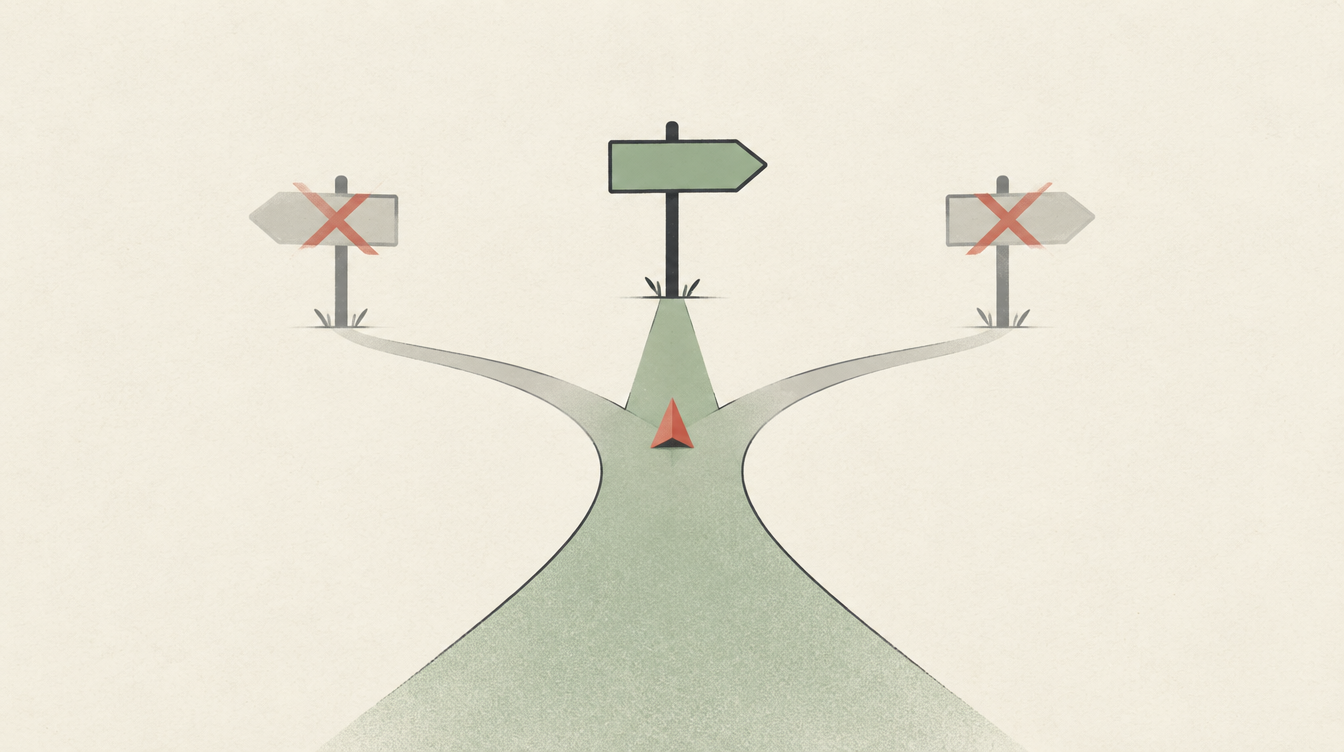

Businesses are constantly told to differentiate themselves.
Stand out. Be unique. Find your competitive advantage. Give customers something they cannot get anywhere else.
The advice sounds right. But it leaves out an important question:
Different in what way, and why should anyone care?
A company can be different without being more valuable. It can offer more features, use newer technology, have a more creative identity, or operate in a completely different way—and still struggle to convince customers to choose it.
Difference attracts attention. Value gives people a reason to act.
Confusing the two is one of the most common mistakes in strategy and marketing.
Not every difference matters
Imagine two software companies serving the same market.
One offers a longer feature list. The other offers fewer features but makes the customer's most important task significantly easier.
Which one is more differentiated?
Technically, both may be. But the more important question is which difference matters to the customer.
A feature is not valuable simply because it exists. A new technology is not an advantage simply because it is new. And a service is not better because it is more sophisticated behind the scenes.
The customer evaluates the difference through a much simpler lens: Does this make something I care about better, easier, faster, safer, or less expensive?
If the answer is unclear, the difference may be real—but commercially irrelevant.
The competitor is not always the real alternative
Another mistake is defining differentiation only in relation to direct competitors.
Companies study what others offer, identify what is missing, and build their positioning around filling that gap.
Sometimes this works. But customers do not always compare products within the categories companies create for themselves.
A customer considering a new software platform might choose a competitor. They might also continue using spreadsheets, rely on an existing process, hire another employee, or simply do nothing.
The real competition is whatever the customer would otherwise do.
This changes the strategic question.
Instead of asking, “How are we different from our competitors?” ask, “Why would a customer change what they are doing and choose us instead?”
That question forces a business to consider the customer's current habits, perceived risks, switching costs, and expectations—not just the features listed on a competitor's website.
More is not always more valuable
When a company struggles to stand out, adding more can feel like the safest response.
More features. More services. More customization. More messages. More benefits.
But every addition introduces a cost. It may increase complexity, confuse the proposition, stretch resources, or make the product harder to explain.
A business can become more capable while becoming less clear.
The result is often a proposition that tries to appeal to everyone and ends up giving no one a compelling reason to choose it.
Strong differentiation does not require being the best at everything. It requires being meaningfully better at something that matters to a defined group of customers.
That focus is not a limitation. It is what makes the value understandable.

A useful difference must be easy to recognize
Even when a company has a genuine advantage, it can struggle if customers cannot recognize it.
The advantage might be buried in technical language, hidden behind a long list of features, or communicated in terms that make sense internally but mean little to the buyer.
This is where strategy and marketing meet.
Strategy determines which advantage deserves to be built and defended. Marketing makes that advantage visible, understandable, and relevant to the people who might value it.
Marketing cannot permanently compensate for an advantage that does not exist. But a real advantage that customers cannot understand may never reach its full potential.
The goal is not simply to claim that you are different. It is to help the right customer understand why that difference matters.
The better question
Before investing in another feature, campaign, product, or positioning exercise, ask three questions:
- Is it different? — Is there a meaningful distinction between what we offer and the alternatives?
- Does it matter? — Does that distinction solve a problem or create value that customers genuinely care about?
- Can customers recognize it? — Can they understand the difference and connect it to a reason to choose us?
If the answer to the first question is yes but the others are no, differentiation may be little more than decoration.
The strongest competitive advantage is not necessarily the most impressive thing a company can do. It is the thing it can do—or deliver—in a way that matters to the customer and gives them a clear reason to choose it.
Being different gets you noticed. Being meaningfully different gives people a reason to choose you.